





Pranayama
Pranayama or the practice of conscious breathing is an important part of yoga. That's because when we pay attention to the breath, it brings us fully into the present.The process by which the Prana is controlled by regulation of external breath is termed as Pranayama. It is impossible to focus on the breath without paying attention to the here and now.
Pranayama is an exact science. It is the fourth Anga or limb of Ashtanga Yoga. Just as a goldsmith removes the impurities of gold by heating it in the hot furnace by strongly blowing the blow-pipe, so also the Yogic student removes the impurities of the body and mind by blowing his lungs, i.e. by practising Pranayama.The aim of Pranayama is to unite the Prana with the Apana and take the united Pranapana slowly towards the head. The effect or fruit of Pranayama is awakening of the sleeping Kundalini.
Five types of prana are responsible for various pranic activities in the body. They are Prana, Apana, Vyan, Udana & Samana. Out of these Prana and Apana are most important. Prana is upward flowing and Apana is downward flowing. Practice of Pranayama achieves the balance in the activities of these pranas, which results in healthy body and mind.Coming Soon in Wixellaneous in Support. Feel free to tell us what you think and give us feedback in the Wix Forum. If you’d like to benefit from a professional designer’s touch, head to the Wix Arena and connect with one of our Wix Pro designers. Or if you need more help you can simply type your questions into the Support Forum and get instant answers. To keep up to date with everything Wix, including tips and things we think are cool, just head to the Wix Blog!
Time for Practice
-
Practicing on an empty stomach is the best especially in the beginning stages of the practice. If you are going to do this after eating, then you won’t be able to do the deep breathing without hurting yourself. So be careful.
-
Whenever you feel fatigued and require a boost in energy and would like to calm your mind and body.Time for PracticePracticing on an empty stomach is the best, especially in the beginning stages of the practice. If you are going to do this after eating, then you won’t be able to do the deep breathing without hurting yourself. So be careful.Whenever you feel fatigued and require a boost in energy and would like to calm your mind and body.
Types Of Pranayama
-
Anulom-Vilom Pranayama
-
Kapal Bhati Pranayama
-
Bhastrika Pranayama
-
Bhramari Pranayama
-
Ujjayi Pranayama
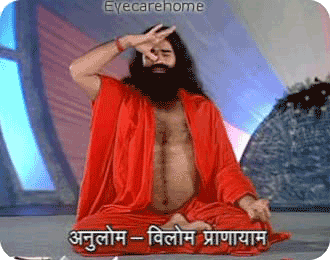
Anulom Vilom Pranayama
This pranayama is also called Nadi Shodhan Pranayama.
Procedure:
-
Sit down in a comfortable yogic position such as Vajrasana or Sukhasana.
-
Close the right side nostril by right hand thumb.
-
Inhale slowly through the left nostril till the lungs are filled with air.Close the left nostril with second and third fingers.
-
Open the right nostril and exhale through it.
-
Repeat the same process starting from right to left nostril and from left to right nostril.This will be one count for anulom-vilom pranayama.
Duration: It should be practiced for 5 to 10 minutes a day depending upon one’s capacity.However during summer it should be practiced for at least 3 minutes and at most
5 minutes.
Benefits: Diseases due to the disturbance of ‘Vata Dosha’ like rheumatism,gout is cured. It cures diseases related to urinary and reproductive organs.Regular practice of this pranayama also cures chronic cough,cold , sinus and cataract.It also removes astama,depression,migraine pain,allergy etc.
Caution: In the beginning do this exercise slowly and increase the speed with more practice.Breath air into lungs and not to stomach as stomach can’t absorb oxygen.Don’t make haste and try to do it slowly as far as possible. If you feel tired then rest for some time and then resume.
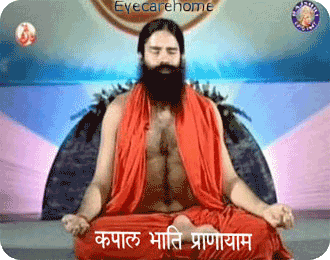
Kapal Bhati Pranayama
Procedure:
-
Sit down in any comfortable yogic position such as Vajrasana or Sukhasana.
-
Stretch your spine upwards and keep your back straight.
-
Relax your stomach muscles.
-
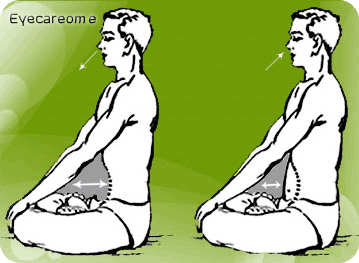
Exhale air forcefully out from both nostril by contracting abdomen.During exhaling, abdomen should be pushed in.
-
Do not inhale consciously i.e allow the inhalation to occur without any extra effort.
-
After inhalation exhale again forcefully and continue at steady rhythm.
Duration: It should be practiced at least 15 minutes a day.
Benefits:
Kapalbati improves blood circulation,respiration and lungs capacity.It helps reduce abdominal fat,obesity and tone abdominal muscles.It improves digestion and eliminates gas.It generates heat in the body to help dissolve toxins and waste matters.Kapalbhati Pranayama is to be used to get cured from illness,weakness, disease and allow good health,vitality and vigor.It Adds luster and beauty to face.
Caution:
Kapalbhati should not be practiced by those suffering from high blood pressure , heart disease ,stroke or epilepsy.Ulcer patients should avoid Kapalbhati pranayama.
Bhastrika Pranayama
Procedure:
-
Sit in any comfortable asana or yogic position of your liking.
-
Breath in through both the nostrils till the lungs are full with air and diaphragm is stretched .
-
Then breath out gently.
Duration:
Inhale for two and half second and exhale for same period in rhythm . One should do it for 5 minutes in one sitting .In the beginning one may take rest in between.Thus Bhastrika pranayama can be done 12 times in a minute and 60 times in 5 minutes.
Benefits:
This pranayama brings proper balance between Vata,Pitta and Kapha the three Doshas.Blood is purified and body gets rid of toxins. Respiratory diseases like cough , cold , asthma , allergy are cured. Lungs become strong and throat diseases like thyroid , tonsils are cured.
Caution:
During summer practice it slowly.
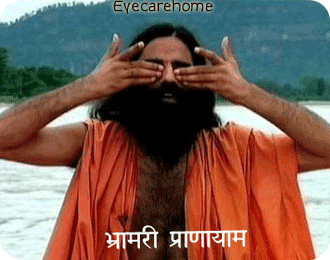
Bhramari Pranayama
This breathing technique derives its name from the black Indian bee called Bhramari. The exhalation in this pranayama resembles the typical humming sound of a bee, which explains why it is named so.
Procedure:
-
Sit up straight with your eyes closed. Keep a gentle smile on your face.
-
Place your index fingers on your ears. There is a cartilage between your cheek and ear. Place your index fingers on the cartilage.
-
Take a deep breath in and as you breathe out, gently press the cartilage. You can keep the cartilage pressed or press it in and out with your fingers, while making a loud humming sound like a bee.
-
You can also make a low-pitched sound but it is a good idea to make a high-pitched one for better results.
-
Breathe in again and continue the same pattern for 6-7 times.
Benefits:
It is an instant way to relieve tension, anger and anxiety. It is a very effective breathing technique for people suffering from hypertension as it calms down the agitated mind.
It gives relief if you're feeling hot or have a slight headache.It helps mitigate migraines.
It Improves concentration and memory.It Helps in reducing blood pressure.
Caution:
Ensure that you are not putting your finger inside the ear but on the cartilage.Don’t press the cartilage too hard. Gently press and release with the finger.While making the humming sound, keep your mouth closed.
Ujjayi Pranayama
Procedure:
-
Contract your throat and it should be like you close the fist by contracting your hand.
-
Inhale deeply and contract your throat and make a sound ‘oo’ ‘oo’ several times during one inhalation.
-
Stop at two-third point of inhalation .
-
Apply Chin lock or Jalandar Bandh and hold the breath to your capacity.
-
Close the right nostril with right thumb and exhale from left nostril.
Duration/Repetition: 3 times
Benefits:
It cures thyroid problems , asthma , snoring etc.


follow us
